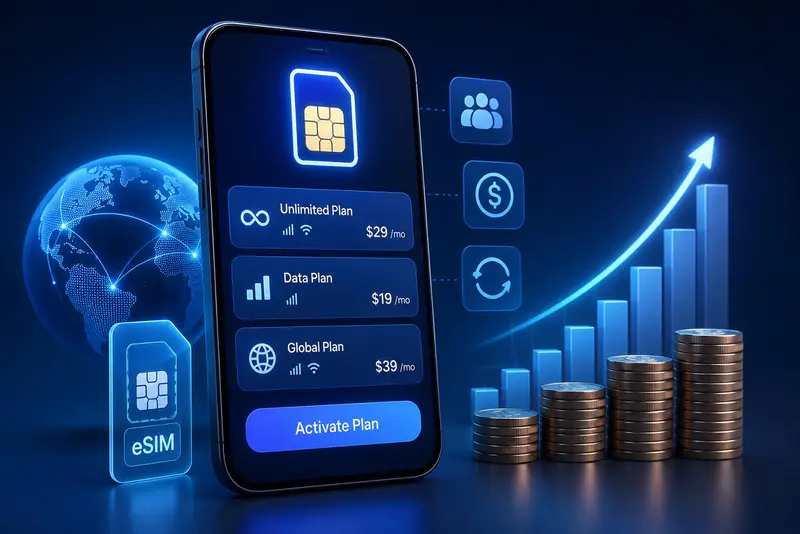
In recent years, mobile connectivity has quietly moved from the edges of the fintech product stack to its center. What started as a perk or as a travel eSIM offered to top-tier customers as a loyalty add-on is becoming a revenue line for the platforms that have figured out the economics.
As such, the next meaningful expansion for many of those platforms isn’t another payments feature or lending product. It’s mobile phone plans.
Gigs is an embedded connectivity platform making that shift possible. Gigs enables any fintech to launch its own branded mobile service. It handles everything from eSIM provisioning to carrier contract management, giving fintechs a path to integrate mobile phone plans without building carrier infrastructure.
How fintechs are turning mobile phone plans into a new product line for their consumers
The way fintechs are approaching mobile services today has split into two distinct strategies, each suited to different stages of product maturity and different risk appetites.
The first is the travel eSIM path. For high-value fintech users like frequent travelers, premium cardholders, and internationally mobile professionals, international roaming fees are one of the most consistent and grating pain points in daily financial life. Offering a travel eSIM as a loyalty benefit or points redemption option addresses that pain with something tangible and immediate without requiring a full mobile service launch.
The second strategy goes further. A branded local phone plan generates its own monthly recurring revenue, builds its own subscriber base, and contributes directly to the platform's ARR. According to Straits Research, the global MVNO market reached $89 billion in 2025 and is projected to nearly double by 2034. Case in point, Sezzle Mobile launched earlier this year, offering unlimited mobile phone plans directly within the Sezzle app.
Industry analysts note that embedded connectivity is following a similar trajectory to embedded payments and embedded lending, where infrastructure providers enable non-telecom brands to offer services that were once restricted to specialized operators. As customer acquisition costs rise across financial services, recurring subscription products are becoming increasingly attractive as a source of sustainable revenue growth.
Both paths apply when building through a platform like Gigs. A fintech can start with a travel eSIM offering and scale to a fully branded phone plan without needing to replace the underlying infrastructure.
How fintechs are making the math for mobile phone plans work
The economics of mobile phone plans have historically favored incumbents. Large carriers absorb the cost of subscriber acquisition through shared advertising channels, celebrity endorsements, and retail footprints. That cost is the central reason why traditional MVNOs and resellers are consistently looking to improve their margins: the current system creates operational overhead without the distribution advantages that make the numbers work.
Fintechs are positioned to flip that equation. A neobank with several million engaged users can reach those users through a push notification or an in-app prompt at effectively zero incremental cost. The subscriber acquisition spending can be a fraction of what traditional carriers spend when a fintech distributes through owned channels.
The trust dynamic further highlights that structural advantage. A Bain & Company report shows the average NPS score for banking and financial services sits at 73, compared to a telecom industry average thathovers around 30, according to data compiled by CustomerGauge. A user who receives a mobile phone plan offer from a trusted brand they already rely on, through an app already open on their phone, doesn’t need convincing. The activation path is a single tap, and the brand equity doing the work was already earned through the core financial product.
Without the CAC and distribution constraints, fintechs can compete on product quality and user experience. According to Gigs, a fintech team can launch a mobile phone plan in a matter of weeks, test product-market fit with their subscriber base, and scale from there without the capital commitment that launching a telecom service used to require.
Why owning the mobile phone plan relationship can compound over time for fintechs
The pattern of differentiation in fintech over the past decade has followed a consistent arc. Payments processing, identity verification, and lending infrastructure each began as externally sourced capabilities handled at arm's length from the core product. The platforms that moved earliest to bring those capabilities into their app pulled ahead in ways that became progressively harder for competitors to catch up.
Mobile connectivity is following the same arc. According to projections cited by Omnius,the global embedded finance market is projected to grow from $63 billion in 2023 to roughly $291 billion by 2033, with connectivity emerging as one of the key verticals within that expansion. The fintechs moving on mobile phone plans now are positioning ahead of a differentiation curve that will be harder to close the longer they wait.
A fintech that builds its mobile services product through Gigs can also iterate on plan design, pricing strategy, and bundling logic without going back to a carrier to renegotiate terms. That kind of product agility is difficult to replicate as a reseller, and it can grow the longer the relationship runs.
How Gigs makes the model work
The revenue and margin case only holds if the infrastructure supporting it is built correctly. Gigs removes from the fintech's operational scope the components of mobile plan infrastructure that consume margin through overhead: carrier contract management, regulatory compliance, network quality negotiation, and provisioning. Each of those functions would otherwise require dedicated in-house telecom expertise that most fintech teams have no reason to build.
What remains with the fintech is the part of the business with revenue-generating potential: plan design, pricing strategy, subscriber acquisition through owned channels, and the product experience that converts an existing user into a paying mobile phone plan subscriber.
The platform also delivers go-to-market intelligence that determines how much of the available margin a fintech actually captures. Gigs provides pricing benchmarks, switching incentive playbooks, and onboarding conversion insights that would take years for a fintech to develop independently. According to the embedded telecom provider, the integration typically takes six to eight weeks, bringing a revenue-generating product to market within a single roadmap cycle.
For fintech operators and investors evaluating where the next meaningful ARPU expansion opportunity lies, Gigs offers a well-defined path to mobile phone plans as a direct revenue line: one with fixed implementation scope, a delivery model proven across multiple launches, and a margin profile that can improve with every subscriber added to the platform.